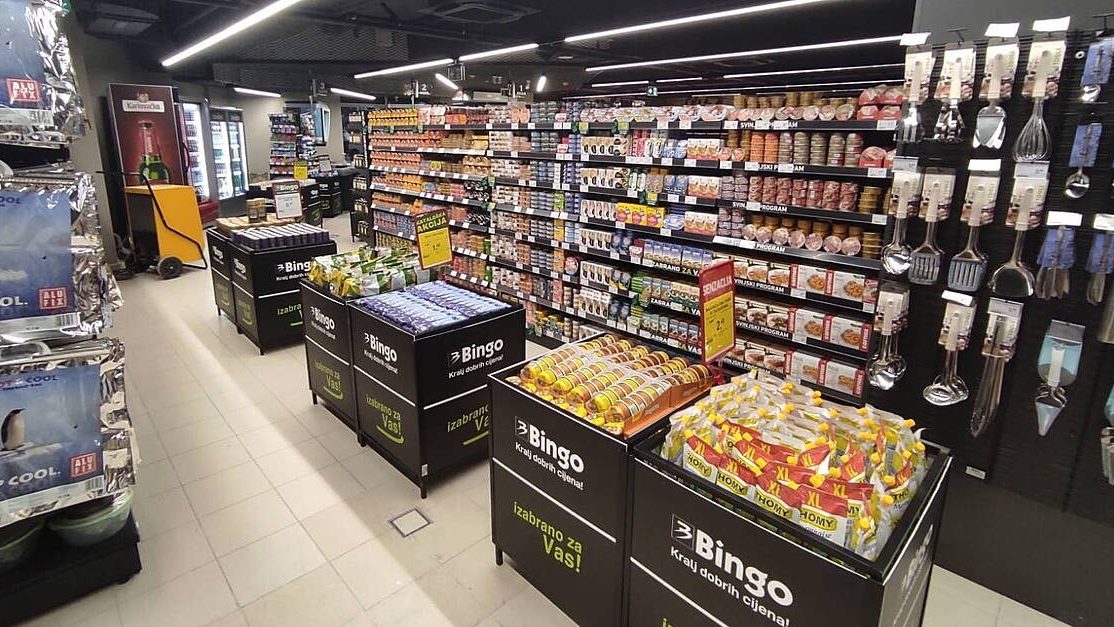
Bingo, the Tuzla-based retail group that is widely regarded as the largest company in Bosnia and Herzegovina, achieved record revenue of around KM 2.3bn (about €1.18bn) in its latest financial year, according to figures reported by Biznis Info.
The result continues several years of growth. Revenue stood at KM 2.18bn in 2024 and KM 1.94bn in 2023, meaning sales have risen by roughly a fifth over two years. Profitability has moved in the opposite direction, however. Net profit fell to approximately KM 128m, down from KM 146m a year earlier and KM 158m in 2023.
Biznis Info did not break down the reasons for the lower profit, but noted that the company had significantly raised employee salaries over the period. Higher wages, energy prices and the cost of an expanding store network have weighed on margins across grocery retail in the region, while governments in the Western Balkans have put pressure on retailers to hold down food prices.
Bingo has continued to expand its network of supermarkets, hypermarkets and shopping centres, and the company is described as one of the country's largest investors, putting money into retail, production capacity and domestic manufacturing. Recent projects include the Bingo City Center in Gračanica, a retail and leisure complex of more than 32,000 square metres, which is being extended in a second phase.
The group's scale gives it a strong position as competition intensifies. Lidl is preparing to open its first stores in Bosnia and Herzegovina in the first half of 2027, supported by a newly opened logistics centre near Kiseljak, and has linked projects to nearly 30 towns and cities. Croatian-owned Konzum remains Bingo's main established rival, with numerous regional and local chains also active.
Bingo began as a small family business in Tuzla and grew into a nationwide group through a mix of organic expansion and acquisitions, and today operates across both of the country's entities.