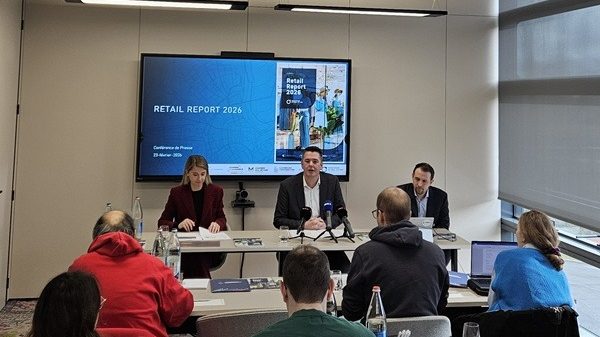
Luxembourg's retail landscape is shifting towards food, discount and hospitality at the expense of fashion and home goods, according to the fourth edition of the country's Retail Report, presented in Luxembourg on 23 February 2026.
The report, created in 2022 under the Pakt Pro Commerce agreement between the government and business organisations, was presented by the Ministry of the Economy, the GIE Observatoire National des PME, the Luxembourg Confederation and the Chamber of Commerce.
Total retail space reached nearly 1.09m sq m at the end of the third quarter of 2025. Because the population has grown by about 10% since 2019, space per inhabitant fell to 1.58 sq m, the lowest level since data collection began. Over the previous twelve months the number of retail businesses rose by 1.1% and hospitality establishments by 3.4%, both slower than population growth.
Food retail was the clear winner. The sector added 110 outlets since 2019, an increase of 18.9%, and its floor space grew by 12%. Hard-discount space expanded by 39.4% and stores specialising in international food by 31.1%. By contrast, the number of fashion and beauty outlets fell by 12%, home furnishings space declined by 6.7% and electronics retailers also lost ground. Fast-food outlets rose 43% to 389, while bars and cafés declined by about 9%.
In town centres, traditional retail's share of ground-floor units dropped from 37.5% in 2019 to 32.2% at the end of 2025 as services and hospitality took over. City-centre vacancy fell to 13.3%, its lowest level in four years, but remained well above the 5.3% rate in shopping centres. Pop-up shops more than doubled over the period.
Economy minister Lex Delles said the findings confirmed that retail was evolving in a fast-changing environment and highlighted support for small businesses' digitalisation and adoption of artificial intelligence. He also plans to extend the Cadastre de Commerce, which maps shop units, beyond town centres to commercial zones.